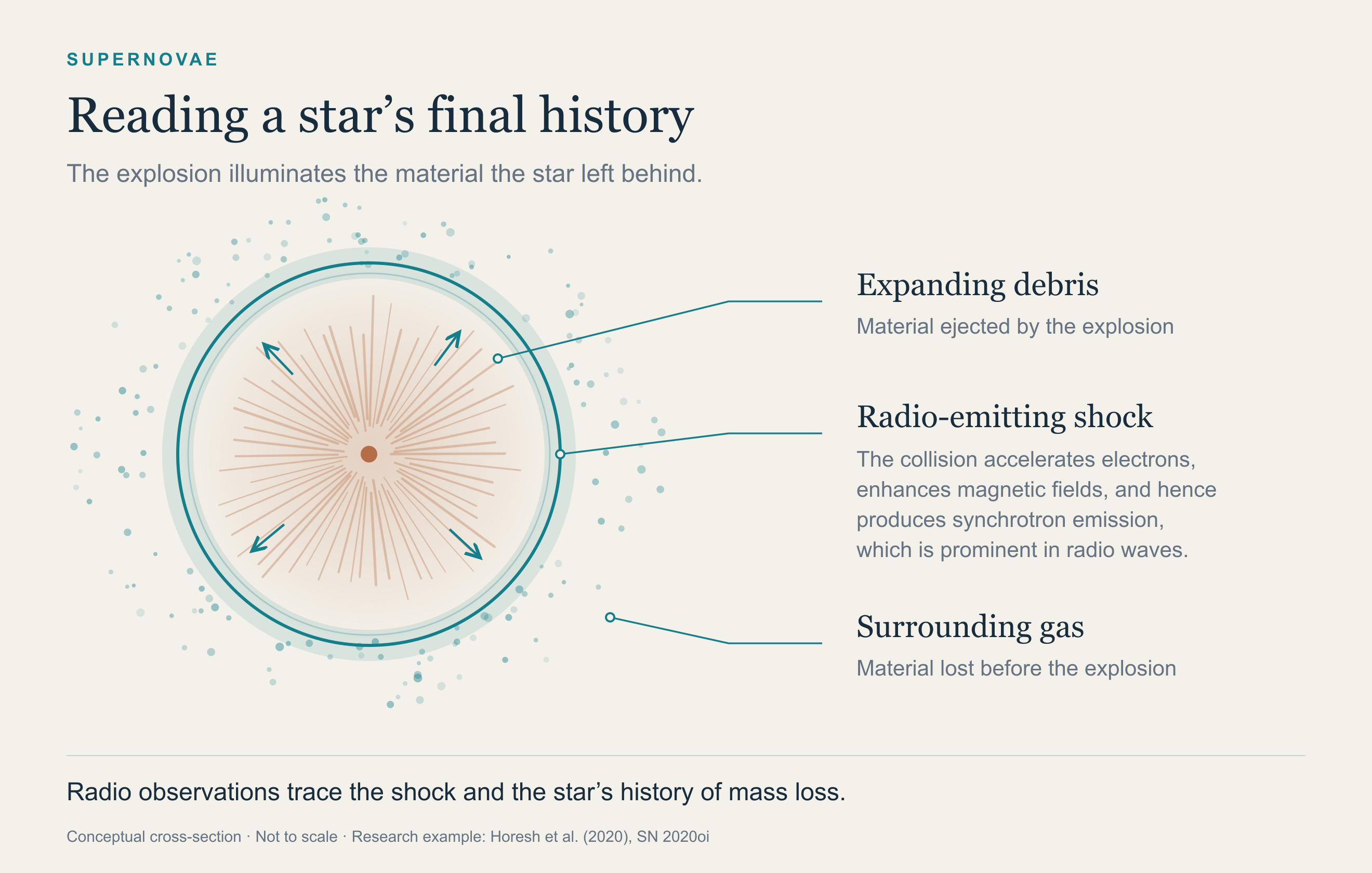
Supernovae are powerful stellar explosions. When a massive star explodes, its expanding debris collides with gas shed during the star’s lifetime. This interaction produces radio emission, allowing us to look back at the star’s history and investigate how it lost material before its death.
I use radio observations, together with optical and X-ray measurements, to study these explosions and their environments. By tracking how the radio emission changes with time and frequency, I investigate the speed of the expanding shock, the surrounding gas, and the physical processes that accelerate particles and amplify magnetic fields. A central question is how mass loss changes during a massive star’s final stages of evolution.
Our group carried out a comprehensive, systematic campaign of repeated radio observations of 99 core-collapse supernovae. Combining these observations with archival data, we studied a sample of 325 explosions to probe the mass-loss histories of supernova progenitor populations. Both radio detections and non-detections provide valuable constraints, helping us test models of stellar mass loss and investigate differences between the stars that produce different types of supernovae. This work is presented in Sfaradi et al. (2025).